Issue No. 08 | August 18, 2026
This week’s highlights…
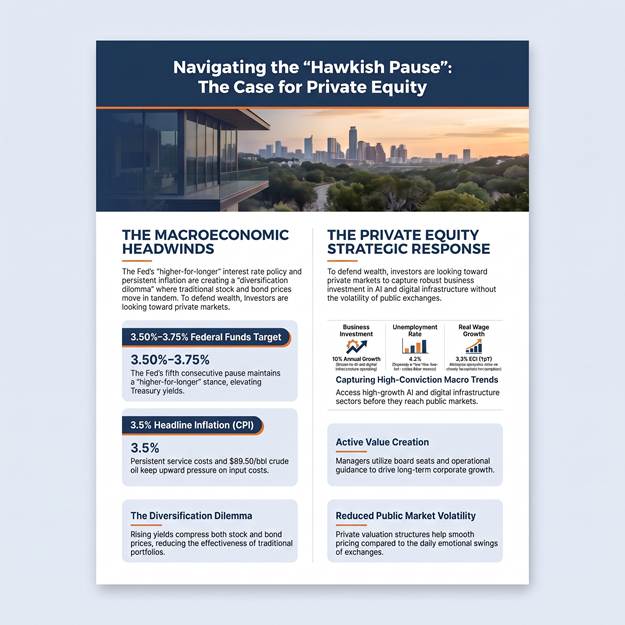
- Federal Reserve Policy: The Fed is maintaining a “hawkish pause” with rates at 3.50%–3.75%, signaling a potential “higher-for-longer” environment due to sticky inflation.
- Economic Resilience: Despite inflationary pressures, the U.S. economy remains resilient, bolstered by a 10% annual increase in business investment in AI and digital infrastructure.
- Labor Market Stability: A “low-hire, low-fire” environment, characterized by a 4.2% unemployment rate and positive real wage growth, continues to dampen recession risks.
- Strategic Diversification: Rising rates can adversely affect both stock and bond prices. For some eligible investors, an appropriately sized allocation to private-market or other alternative strategies may complement a traditional portfolio, subject to substantial risks, costs, illiquidity, and suitability considerations. Diversification does not assure a profit or protect against loss.
The Fed’s Hawkish Pause: A Higher-for-Longer Outlook
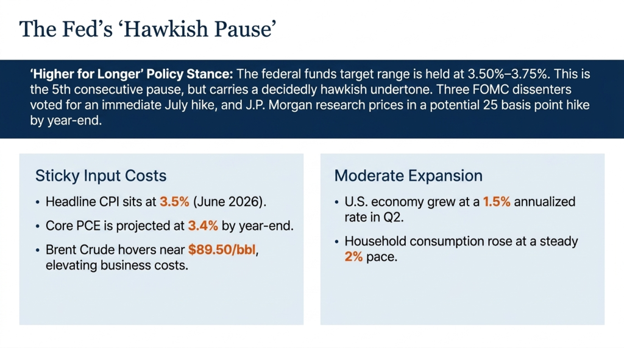
The Federal Reserve recently held its federal funds target range at 3.50%–3.75%, marking its fifth consecutive pause. However, this pause carries a hawkish undertone: three FOMC members dissented from the July 29, 2026 decision and preferred a 25-basis-point increase.
This “higher-for-longer” policy stance continues to elevate Treasury yields and weigh on interest-sensitive sectors like residential real estate.
Persistent Price Pressures Meet Resilient Business Investment
Why the caution? Headline CPI stood at 3.5% in June 2026, with core PCE projected around 3.4% at year-end. Though core goods prices decreased 0.1% monthly in Q2, sticky services and Brent crude near $89.50 per barrel introduce volatile input costs for businesses.
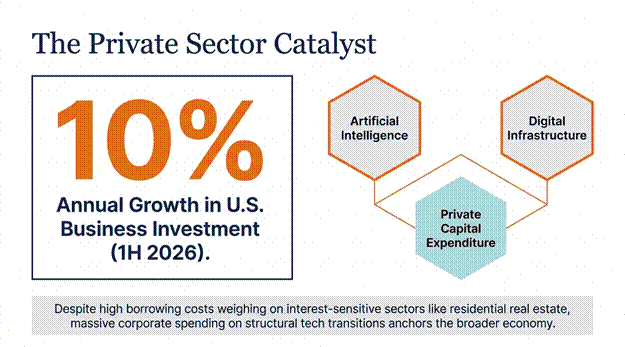
Yet, the U.S. economy continues to expand at a moderate pace, growing at a 1.5% annualized rate in Q2 2026 following a 2.1% advance in Q1. This resilience is anchored by business investment, which grew at a 10% annual rate in the first half of the year, driven by private capital expenditure on artificial intelligence and digital infrastructure. Meanwhile, household consumption rose by a steady 2% pace.
A “Low-Hire, Low-Fire” Labor Market
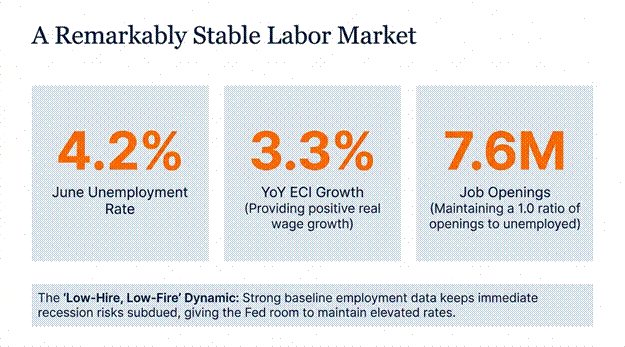
Supporting this resilience is a “low-hire, low-fire” labor market. The unemployment rate was 4.1% in July 2026.
The Employment Cost Index (ECI) rose 3.3% year-over-year through June, providing positive real wage growth. With job openings steady at 7.6 million and a job-openings-to-unemployed ratio of 1.0, recession risks remain subdued.
The Diversification Dilemma
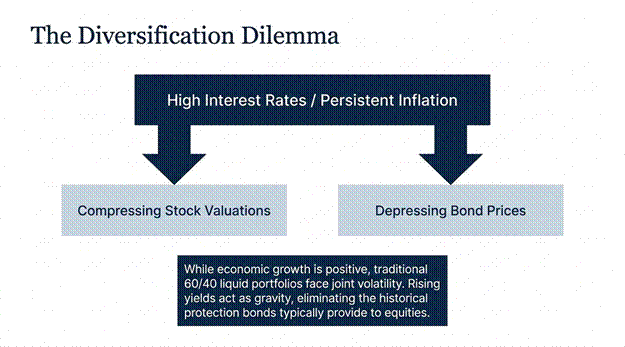
While steady growth and tech spending are positive, persistent inflation and high interest rates create joint volatility for traditional portfolios, as rising yields compress both stock and bond prices.
At Halbert Wealth Management, our absolute-return, risk-aware philosophy is designed for exactly these conditions. To manage risk and smooth volatility, we believe investors must look beyond traditional liquid markets. Integrating non-traditional, non-correlated strategies can help expand return potential while actively defending your wealth against interest rate and inflation shocks.
What You’re Missing: Accessing Growth via Private Equity
When traditional public markets face identical headwinds, where can accredited investors look for long-term growth? The answer often lies in Private Equity—a private market strategy that provides capital directly to private companies, allowing investors to participate in long-term corporate value creation outside public markets.
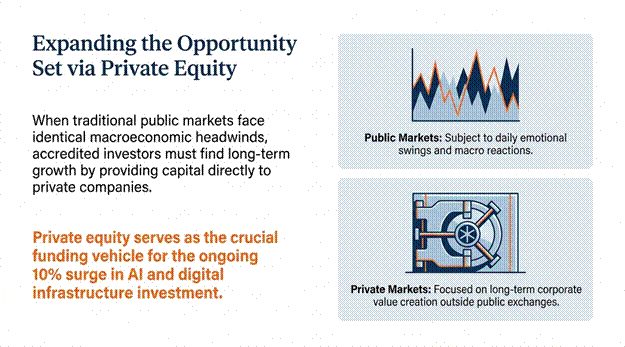
With overall US business investment expanding at a robust 10% annual rate, particularly in high-growth areas like artificial intelligence and digital infrastructure, private equity can act as a crucial vehicle for funding these massive technology transitions. Rather than being subject to the daily emotional swings of public exchanges, private equity strategies take an active, long-term approach to building and scaling businesses.
Here is a quick 3-Step Explainer on how private equity can benefit qualified portfolios:
- Capitalization on Macro Trends: Private equity funds can target high-conviction, high-growth sectors, such as the digital infrastructure and AI companies driving the current capital expenditure boom, before they ever reach public markets.
- Active Value Creation: Private equity managers take direct board seats and guide corporate strategy, operational improvements, and expansion plans to drive long-term business growth.
- Reduced Public Market Volatility: Private equity investments are not traded daily on public exchanges. While they are illiquid and require a longer-term commitment, this valuation structure can help smooth pricing volatility in a broader portfolio.
Important risks: Private market investments are speculative, illiquid, and generally intended only for eligible investors who can bear the loss of their entire investment and an extended holding period. Risks may include limited transparency and transferability, uncertain or infrequent valuations, capital calls, leverage, concentration, significant fees and expenses, manager and strategy risk, and delayed or absent distributions. Less-frequent valuation may make reported returns appear less volatile than public-market returns, but does not reduce underlying economic risk and may cause valuations to lag market conditions. Diversification does not assure a profit or protect against loss.
| Ready to learn more? Take the Next Step Are you curious about how alternative strategies like private equity or custom portfolio designs can fit into your existing wealth plan? Let’s take a look together. Contact us to schedule a brief, educational consultation with our team. We will help you analyze your current asset allocation and discuss bespoke, private-market opportunities designed to navigate today’s “higher-for-longer” macroeconomic reality. |
Infographic Summary

Spencer Wright is the Executive Vice President of Halbert Wealth Management, Inc. and the author of Forecasts & Trends. He has been with HWM for over 25 years.