The Quick Take…
- Main Market Takeaway: Pre-election uncertainty routinely compresses equity valuations and sparks short-term volatility, but historical data shows policy shifts rarely alter long-term market trajectories.
- Core Analysis Theme: The structural disconnect between political headlines and market performance, highlighting predictable pre-midterm weakness versus post-election rallies.
- Featured Alternative Spotlight: Options designed to harvest political volatility and maintaining asymmetric equity participation with long/short equity strategies.
The Lead
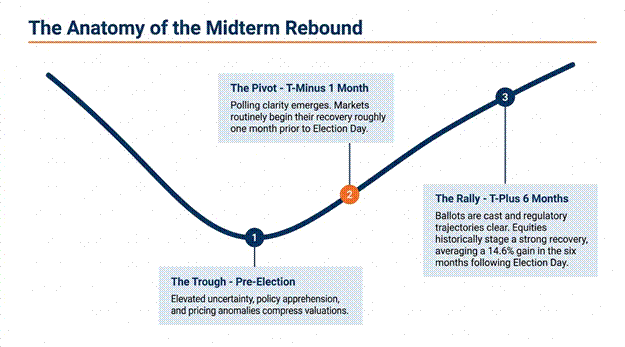
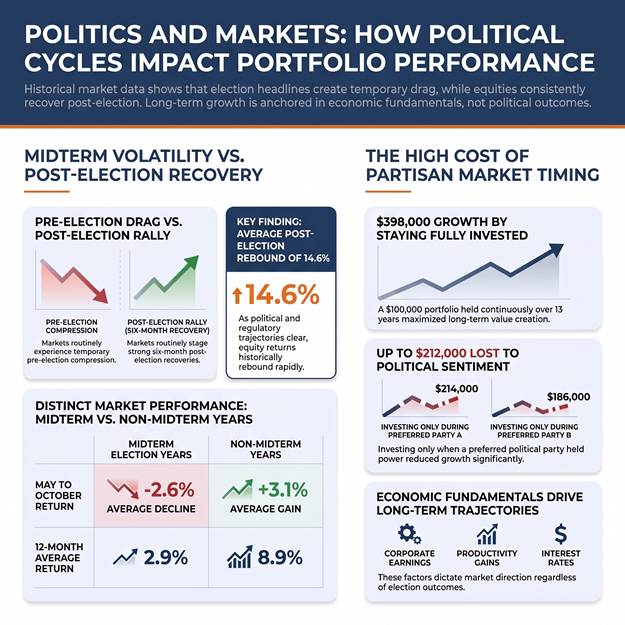
Wall Street focuses heavily on Capitol Hill during election cycles, yet market behavior routinely defies partisan narratives. In midterm election years, equity markets typically experience pre-election drag, declining an average of 2.6% between May and October compared to a 3.1% gain during non-midterm periods. This weakness stems from policy uncertainty rather than deteriorating economic health.
Once ballots are cast and regulatory trajectories clear, equities historically stage strong recoveries, averaging a 14.6% gain in the six months following Election Day. Investors who alter portfolio allocations based on political sentiment frequently suffer performance penalties, making structural risk management far more effective than trying to forecast congressional seat shifts.
The Core Analysis
The Pre-Election Volatility Pattern
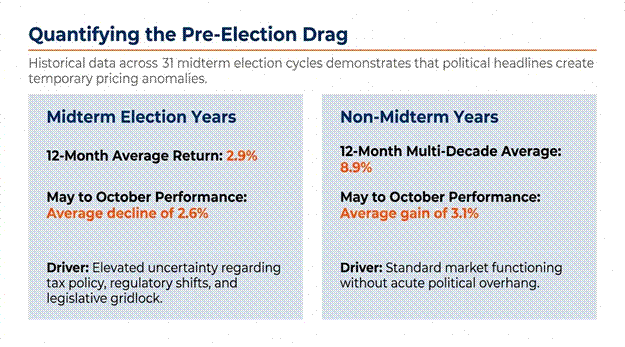
Historical data across 31 midterm election cycles demonstrates that political headlines create temporary pricing anomalies. Equity returns during the twelve months leading into midterm elections average just 2.9%, well below the 8.9% multi-decade average for non-midterm years. This muted performance reflects elevated uncertainty regarding tax policy, regulatory shifts, and legislative gridlock. However, this drag is temporary. Research shows that stock prices routinely begin rallying roughly one month before Election Day as polling clarity emerges, delivering average six-month post-election gains of 14.1%.
Fundamentals Over Fractious Politics
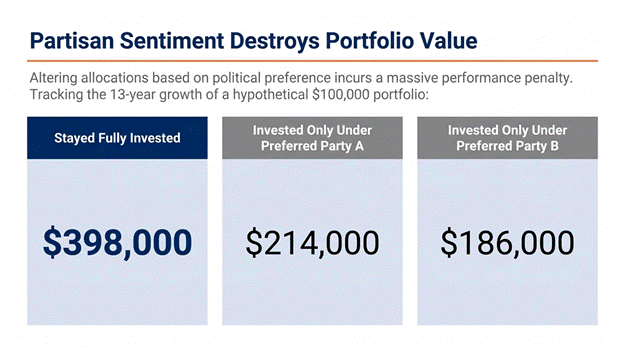
Party control of Congress or the White House bears surprisingly little correlation with long-term equity returns. Single-party rule and divided government have both generated historical annualized returns near double digits. For instance, a hypothetical investor who moved to cash whenever their non-preferred political party held power would have reduced a $100,000 portfolio growth from $398,000 down to $214,000 or $186,000 over a thirteen-year span.
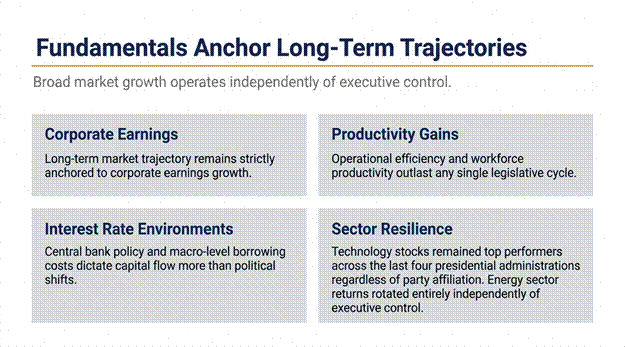
Sector performance similarly refutes political assumptions: technology stocks remained top performers across the last four presidential administrations regardless of party affiliation, while energy sector returns rotated independently of executive control. Long-term market trajectory remains anchored in corporate earnings growth, productivity, and interest rate environments rather than legislative composition.
What You’re Missing
Traditional stock and bond portfolios treat the midterm rally as a pure buying opportunity, taking on full market risk just as long-term gridlock sets in. Institutional investors handle this transition differently by using options overlays and market-neutral strategies.
Utilizing long-short equity or non-correlated alternative fixed income allows portfolios to seek returns without relying on direction from the broader market. These alternative strategies help cushion downturns, convert volatility into yield, and generate returns independent of election results.
Ready to learn more?
To see how options and long/short equity can protect your wealth through election cycles, schedule a call with our team.
This Caught My Eye
I have always been an avid watcher of elections. Gary and I used to spend hours sitting together, analyzing polling data, mapping out swing districts, and musing over potential outcomes. As things stand today, my baseline prediction is that Democrats will secure a narrow majority in the House while Republicans hold their majority in the Senate.
A divided Capitol Hill would bring immediate legislative gridlock, which fits precisely with the historical market setup discussed above. When leadership is split, sweeping policy changes stall, giving markets the structural predictability they prefer.
Infographic Summary
Halbert Wealth Management is an SEC-registered investment advisor. Investments in alternative strategies are speculative, involve substantial risk of loss, and are not suitable for all investors. Past performance does not guarantee future results.

Spencer Wright is the Executive Vice President of Halbert Wealth Management, Inc. and the author of Forecasts & Trends. He has been with HWM for over 25 years.