| The Quick Take… Main Takeaway: Decumulation converts equity market drawdowns into permanent capital loss through reverse dollar-cost averaging. Core Analysis: Path dependency dominates retirement portfolios, leaving traditional 60/40 models and static withdrawal rules vulnerable to volatility. Featured Alternative: Private credit and equity market neutral strategies combine to generate uncorrelated yield and harvest volatility without forcing equity liquidations. |
The Lead
Accumulating wealth rewards patience during market panics. When new capital flows into a portfolio each month, stock declines function as buying opportunities, allowing systematic investors to acquire equity shares at discounted prices. When transitioning to decumulation, that mathematical advantage reverses completely.
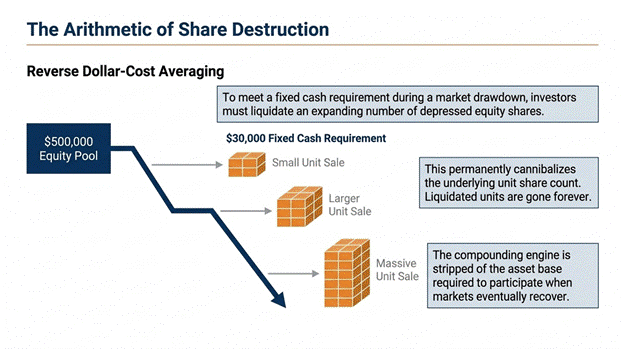
Taking living distributions from a falling portfolio forces reverse dollar-cost averaging. To meet fixed cash requirements, an investor must liquidate an increasing number of depressed equity shares. This permanently cannibalizes the underlying unit share count. Those liquidated units are gone forever, stripping the compounding engine of the asset base required to participate when markets eventually recover. When early retirement drawdowns collide with rigid distribution needs, poor sequence of returns can permanently break a portfolio regardless of multi-decade average returns.
The Core Analysis
The Arithmetic of Share Destruction
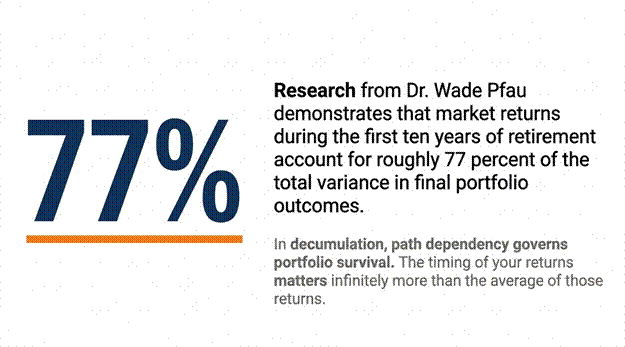
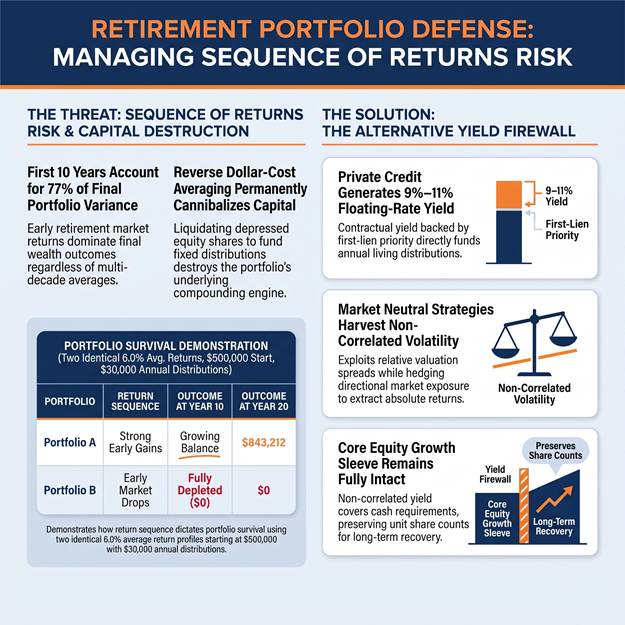
In pure accumulation, return order does not affect final wealth because multiplication is commutative. In decumulation, path dependency governs portfolio survival. Research from Dr. Wade Pfau shows that market returns during the first ten years of retirement account for roughly 77 percent of the total variance in final portfolio outcomes.
Consider two portfolios starting with 500,000 dollars and a 30,000 dollar annual distribution. Both achieve an identical 6.0 percent average annual return over twenty years. Portfolio A experiences strong gains in its early years, expanding its balance and ending with 843,212 dollars. Portfolio B faces the exact reverse return sequence: early market drops force the sale of cheapened shares to fund distributions. By Year 10, Portfolio B reaches complete depletion. The arithmetic of unit share cannibalization leaves zero capital to participate in later market recoveries.
The Breakdown of Public Benchmarks
For three decades, financial planning relied on William Bengen’s 4.0 percent rule, calibrated against the 1966 stagflation cohort. Modern market conditions have strained that baseline. Morningstar research indicates that under low starting bond yields and high equity valuations, forward-looking safe withdrawal rates fell as low as 3.3 percent.
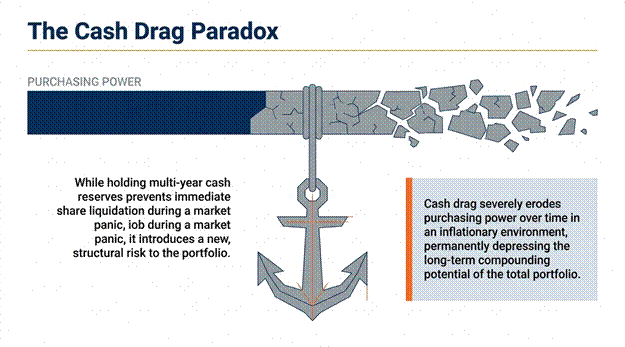
The 2022 inflation shock exposed another vulnerability: public bonds failed as a shock absorber. Traditional 60/40 portfolios dropped 16 to 21 percent alongside equities. Retirees taking systematic distributions were forced to sell both asset classes at depressed valuations. Meanwhile, holding multi-year cash reserves introduces severe cash drag, eroding purchasing power and depressing total long-term portfolio growth.
What You’re Missing
Traditional stock-and-bond allocations force investors to choose between equity market drawdowns and low-yielding bond duration. Institutional allocators resolve this trade-off by combining private credit with equity market neutral strategies in a dedicated alternative sleeve.
Senior secured private credit generates floating-rate contractual yields, backed by first-lien priority and financial maintenance covenants. Pairing private credit with market neutral strategies introduces non-correlated absolute return. Equity market neutral funds exploit relative valuation spreads between individual stocks while hedging out directional market exposure, extracting alpha and harvesting volatility regardless of whether broad equity indexes rise or fall.
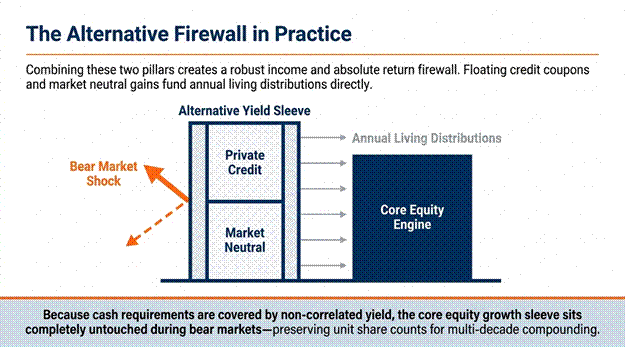
Combining these two pillars creates a robust income and absolute return firewall. Floating credit coupons and market neutral gains fund annual living distributions directly. Because cash requirements are covered by non-correlated yield, the core equity growth sleeve sits completely untouched during bear markets, preserving unit share counts for multi-decade compounding.
| Ready to learn more? Schedule a portfolio review with our team to explore our alternative yield options. |
This Caught My Eye
Here is something a little different. Rush is the greatest rock band of all time. I reject all counter arguments. As a power trio, Geddy Lee, Alex Lifeson, and Neil Peart generated intricate, almost orchestral sound without backing tracks. Rush was known for their complex time signatures and memorable melodies. Peart’s lyrics elevated the genre into literature. Across four decades, they fearlessly evolved from heavy blues and sprawling progressive epics to new wave and hard rock. Sustaining an unbroken, drama-free brotherhood, Rush proved that rock could be technically brilliant, commercially viable, and deeply thoughtful all at once.
Infographic Summary
Halbert Wealth Management is an SEC-registered investment advisor. Investments in alternative strategies are speculative, involve substantial risk of loss, and are not suitable for all investors. Past performance does not guarantee future results.

Spencer Wright is the Executive Vice President of Halbert Wealth Management, Inc. and the author of Forecasts & Trends. He has been with HWM for over 25 years.