The Quick Take…
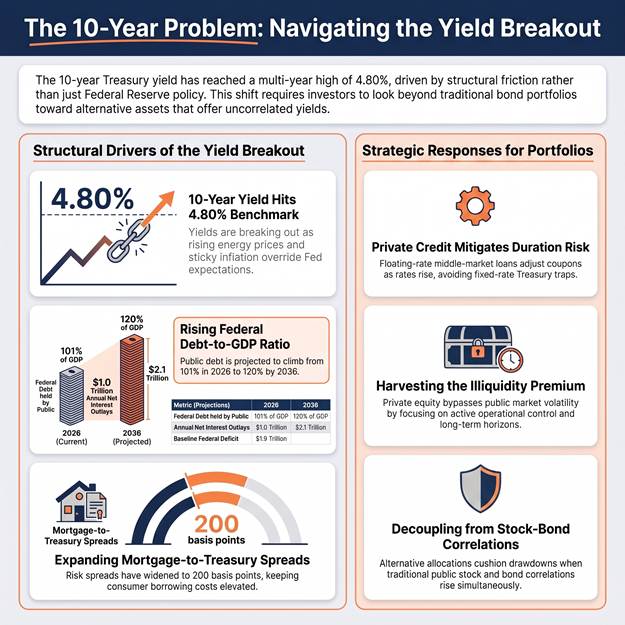
- The Benchmark Breakout: The 10-year Treasury yield hit 4.80% as rising energy prices and sticky core inflation expectations override hopes of a near-term Fed policy pivot.
- The Structural Friction: Growing federal deficits and elevated mortgage spreads are keeping borrowing costs high, regardless of the Fed’s next target rate decision.
- The Alternative Angle: Alternative fixed income and absolute-return strategies offer a way to generate uncorrelated yield and cushion drawdowns without taking on duration risk.
The Lead
The 10-year Treasury yield rose to 4.80% on September 1, 2026, reaching its highest level since January 2025. While the financial press remains obsessed with the Federal Reserve’s next policy rate move, the real action is unfolding in the long end of the curve.
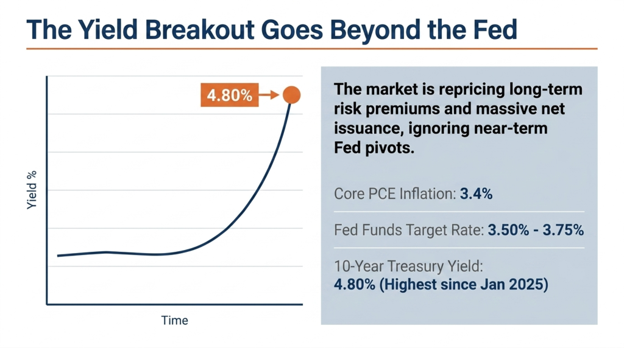
The 10-year yield is forward-looking, pricing collective expectations for inflation, growth, and fiscal supply over the next decade. With core PCE inflation running at 3.4% and the Fed funds rate held at 3.50% to 3.75%, the 10-year yield is breaking out. This is not just about monetary policy: the end of balance sheet runoff has forced private markets to digest massive net issuance, triggering a quiet repricing of long-term risk premiums.
The Fiscal Feed-Back Loop
The first structural driver is the pure volume of sovereign issuance. The Congressional Budget Office projects that federal debt held by the public will rise from 101% of GDP in 2026 to 120% in 2036, driven by a baseline deficit of $1.9 trillion this year alone. When the government borrows at this rate, it competes directly with other long-duration assets for private capital.
Net interest outlays are projected to double from $1.0 trillion in 2026 to $2.1 trillion in 2036, compounding our fiscal imbalances. To fund this expansion, the Treasury must auction more coupons, forcing private markets to absorb supply and prompting investors to demand a higher term premium (the extra compensation required to hold longer-term debt instead of rolling over short-term bills).
The Stubborn Mortgage Spread
This interest rate pressure travels directly into consumer and real estate markets. Long-term mortgage rates do not price off the Fed’s overnight target; they anchor directly to the 10-year Treasury yield plus a persistent risk spread. Historically, this mortgage-to-Treasury spread has averaged around 150 basis points, but it has expanded to nearly 190 to 200 basis points in 2026.
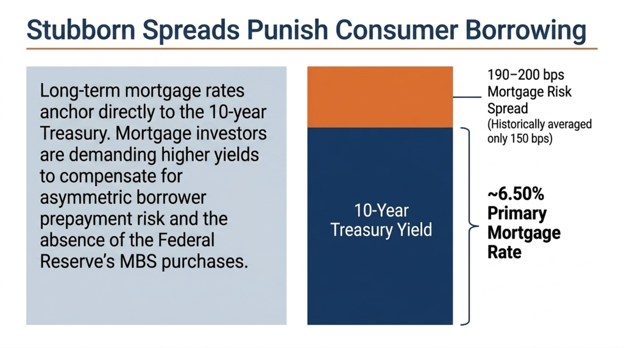
Mortgage investors are demanding higher yields to compensate for borrower prepayment options (the asymmetric risk that borrowers refinance when rates drop) and the Fed’s reduced footprint in purchasing mortgage-backed securities. As long as this spread remains wide, primary mortgage rates will hang around 6.50%, demonstrating how the 10-year Treasury dictates overall borrowing conditions.
What You’re Missing
In an environment where correlations between publicly traded stocks-and-bonds may increase, allocations to private credit and private equity may provide differentiated sources of risk and return. However, these private investments do not necessarily protect against market declines and may experience significant losses. Traditional fixed-rate bonds may also be sensitive to changes in interest rates, inflation expectations and term premiums.
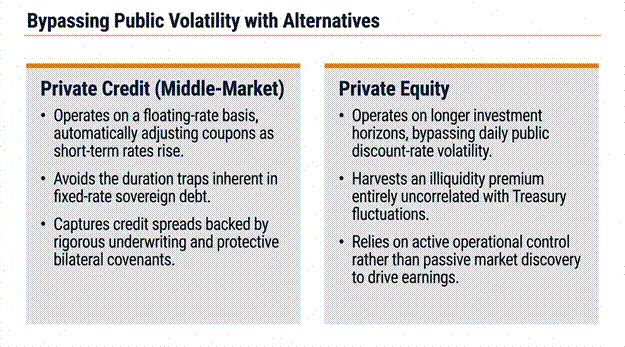
To manage this duration risk, institutional managers are looking beyond public markets. Private credit, particularly middle-market direct lending, operates largely on a floating-rate basis, adjusting coupons as short-term rates rise. Because many middle-market private loans have floating interest rates, they may have less interest-rate sensitivity than longer-duration fixed-rate bonds. However, private credit remains subject to credit, default, liquidity, leverage, valuation and borrower-specific risks, and underwriting standards and covenant protections vary materially among investments and managers..
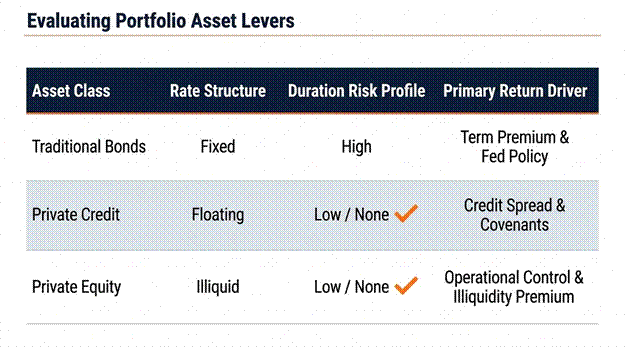
Private equity strategies invest over longer time horizons and may seek to generate returns through operational improvements, business growth and eventual liquidity events. Because private investments are valued less frequently than publicly traded securities, reported volatility and correlation may appear lower and may not fully reflect changes in underlying economic value. Private equity investments remain subject to substantial risks, including illiquidity, leverage, valuation uncertainty, business failure, concentration risk and loss of principal.
Ready to learn more?
To see how these structural shifts affect your asset allocation, schedule a brief portfolio review with our advisory team to discuss active risk management strategies.
This Caught My Eye
I recently reread AI Superpowers by Kai-Fu Lee, and its thesis on the commercialization of artificial intelligence is highly relevant today. Lee argues that the era of AI discovery has transitioned into an era of implementation, where raw computing power and massive datasets are more valuable than pure academic breakthroughs.

He focuses on the intense competition between the U.S. and China, illustrating how rapid, entrepreneurial execution can redefine global economic dominance. It is a compelling look at how technological platforms are scaled, and a stark reminder that the ultimate winners in any tech transition are often those who master distribution and commercialization rather than the initial creators.
Infographic Summary

Spencer Wright is the Executive Vice President of Halbert Wealth Management, Inc. and the author of Forecasts & Trends. He has been with HWM for over 25 years.