The Quick Take
- Broad semiconductor and polysilicon tariffs are imposing a compounding, regressive tax across key technology and manufacturing sectors, altering historical trade flows.
- Massive corporate artificial intelligence expenditures and hardware costs are rising, which is fueling core goods inflation and crowding out consumer retail electronics demand.
- Active absolute-return management through dynamic options overlays and long/short equity can harvest heightened tech-sector volatility
The Lead
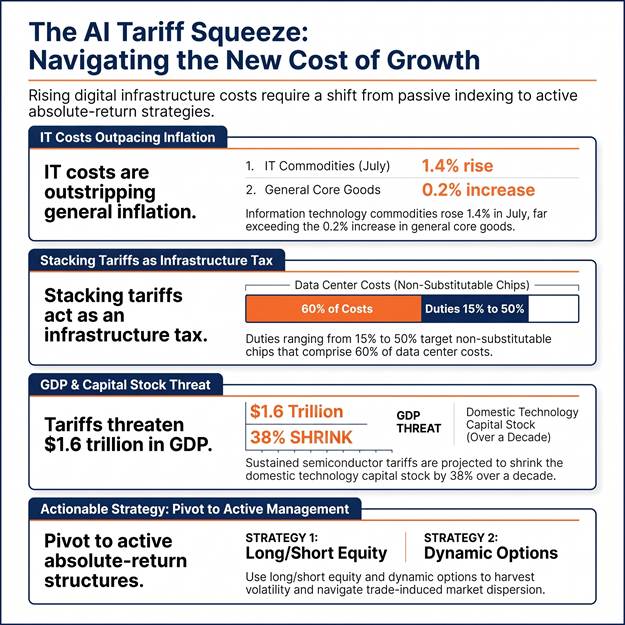
While headline inflation has cooled from its post-pandemic peaks, a quiet price acceleration is unfolding beneath the surface of the core goods basket. The massive corporate buildout of artificial intelligence is directly competing with everyday consumers for critical hardware inputs. In July, information technology commodities rose a steep 1.4% month-over-month, far outstripping the modest 0.2% increase in general core goods.
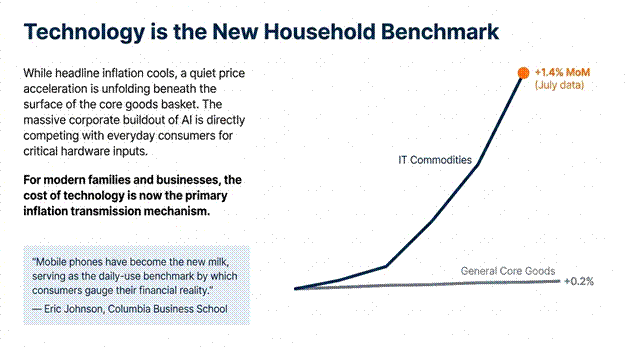
To understand the true cost of living today, we must look beyond basic household staples. Columbia Business School professor Eric Johnson recently observed that mobile phones have become the new milk, serving as the daily-use benchmark by which consumers gauge their financial reality. For families and businesses, the cost of technology is now the primary inflation transmission mechanism.
Squeezing the AI Bedrock
The administration’s trade strategy has introduced a dual-front squeeze on technology supply chains. Under the January Section 232 action, imported advanced computing chips face a 25% tariff. This protectionist barrier was widened on August 6 with a new presidential proclamation imposing a 15% ad valorem tariff on polysilicon derivatives, including ingots, wafers, cells, and modules, paired with a Minimum Import Price of $21 per kilogram for raw polysilicon.
These tariffs stack directly on top of existing 50% Section 301 duties on Chinese-origin semiconductors, with another phased Section 301 increase scheduled for June 2027.
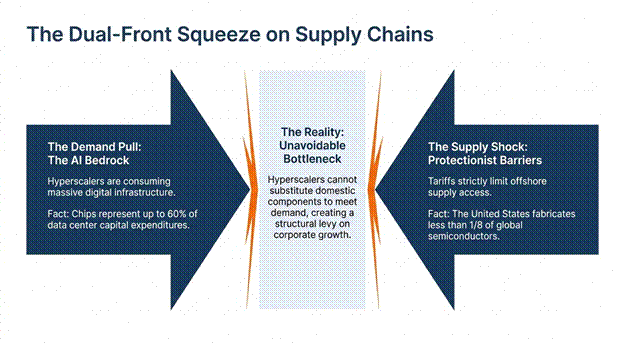
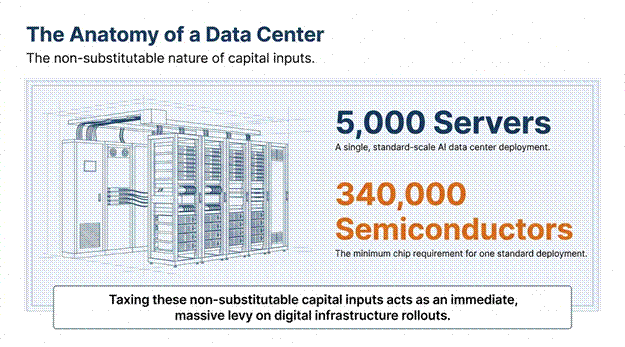
This is particularly painful for artificial intelligence infrastructure. Chips represent up to 60% of data center capital expenditures. Because the United States fabricates less than one-eighth of global semiconductors, hyperscalers cannot simply substitute domestic components. A standard 5,000-server data center requires at least 340,000 semiconductors; taxing these non-substitutable capital inputs acts as an immediate levy on digital infrastructure.
The Capital Starvation Loop
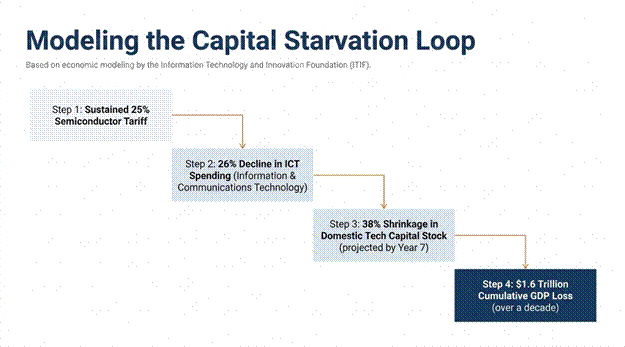
The macroeconomic consequences are highly regressive. Modeling by the Information Technology and Innovation Foundation shows that a sustained 25% semiconductor tariff would trigger a 26% decline in information and communications technology spending. This capital starvation is projected to shrink the domestic technology capital stock by 38% by year seven, culminating in a $1.6 trillion cumulative GDP loss over a decade.
For households, the policy translates to an average $122 annual reduction in real income. Rather than isolating competitors, unmitigated tariffs threaten to compress corporate margins, restrict research budgets, and drive manufacturers to relocate facilities outside the country to access affordable raw materials.
What You’re Missing
Traditional stock-and-bond portfolios are structurally unprepared for trade-induced cost spikes and geopolitical gridlocks. When global supply chains fracture, the resulting market dispersion creates clear winners and losers, making passive index tracking a losing proposition. To thrive in this high-friction environment, sophisticated investors are rotating toward active absolute-return structures such as long/short equity strategies and dynamic options strategies.

| Ready to learn more? Next Step: Contact our advisory team today to request a personalized, custom portfolio stress-test analysis. |
What Caught My Eye
I have been tracking an extraordinary shift in how Washington is fighting the critical minerals war. Historically, industrial policy relied on tax credits or quotas. Today, the Pentagon is acting like a venture capital fund. Since January 2025, the federal government has poured $10 billion into critical minerals, including a $400 million purchase that made the taxpayer the largest shareholder in MP Materials, which operates California’s Mountain Pass rare earth mine.
I am a fan of the All-In Podcast. It is a weekly video podcast covering venture capital, macroeconomics, tech trends, politics, and science. Originally started during the 2020 lockdowns, the show began as a recorded version of the private discussions and debates among a group of Silicon Valley investors and long-time poker buddies. It is worth a look.
Infographic Summary

Spencer Wright is the Executive Vice President of Halbert Wealth Management, Inc. and the author of Forecasts & Trends. He has been with HWM for over 25 years.