The Quick Take
- Market Takeaway: Mainstream employment reports offer coincidence confirmation of current conditions, rather than functioning as predictive gauges for upcoming economic trends.
- Core Analysis Theme: First-release payroll numbers are frequently undermined by diminished survey participation, heavy reliance on birth-death model projections, and substantial downstream benchmark adjustments.
- Alternative Spotlight: Adopting market neutral fixed income strategies insulates portfolios from macro-driven whipsaw risk.
The Lead
Wall Street treats the monthly Employment Situation report like an oracle, moving equity futures and Treasury yields within seconds of its release. Yet treating headline nonfarm payroll gains as a reliable gauge of real-time economic health misinterprets how the Bureau of Labor Statistics constructs its data.
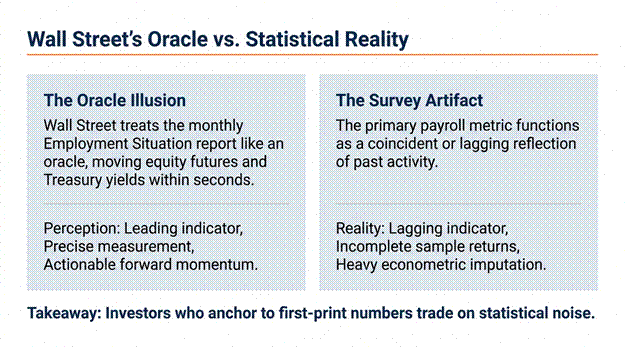
The primary payroll metric functions as a coincident or lagging reflection of past activity rather than a leading forecast of forward momentum. Initial prints are generated from incomplete sample returns, relying heavily on econometric imputations to guess business formation. Investors who anchor asset allocation decisions to first-print employment numbers often trade on statistical noise, mistaking delayed survey artifacts for turning points in broader macroeconomic conditions.
The Measurement Lag in First Prints
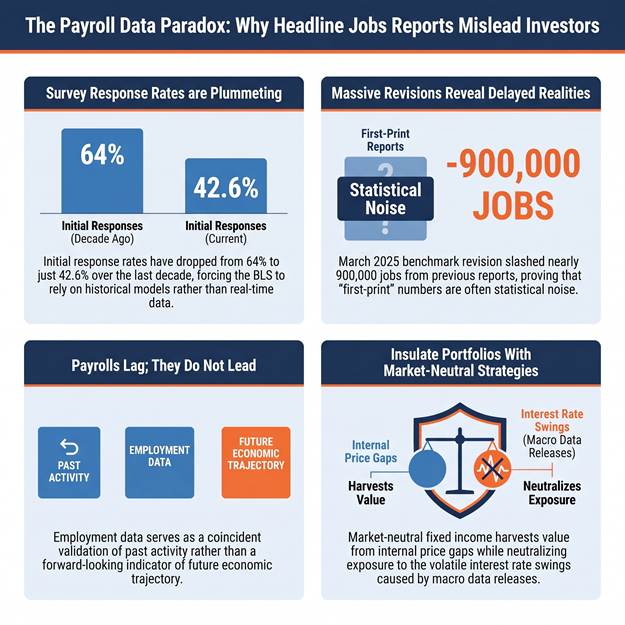
The Current Employment Statistics survey attempts to measure monthly job creation by sampling nonfarm establishments, but initial response rates have dropped significantly, falling from roughly 64 percent a decade ago to near 42.6 percent in recent periods. To fill sample gaps, the agency uses a Net Birth-Death model that relies on historical time-series trends to estimate unobserved business formations.
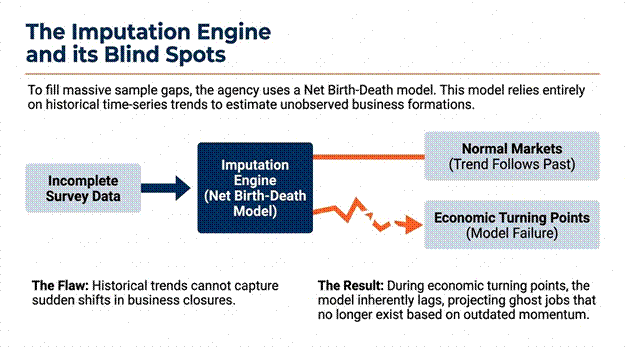
During economic turning points, this model inherently lags because historical trends cannot capture sudden shifts in business closures. Consequently, first-print payroll numbers carry a wide 90 percent confidence interval of plus or minus 122,000 jobs, meaning small monthly changes lack statistical significance.
Revisions Reveal the Delayed Reality
The true state of labor demand only emerges after extensive revision cycles. Annual benchmark revisions align monthly survey estimates with state unemployment insurance tax records. The scale of these adjustments can be staggering: the March 2025 benchmark revision reduced nonfarm payroll levels by 898,000 jobs, trimming 2025 annual payroll growth from an initially reported 584,000 down to just 181,000.
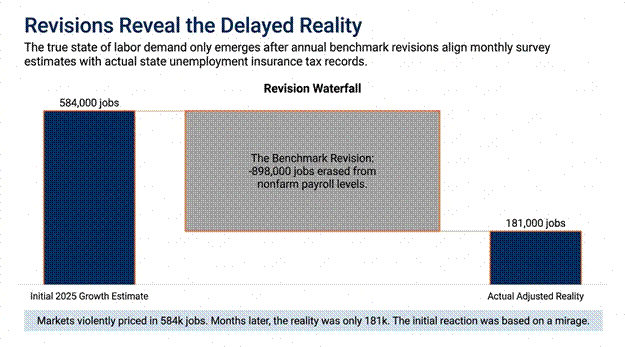
Employment data confirms where the economy has been, not where it is heading.
What You’re Missing
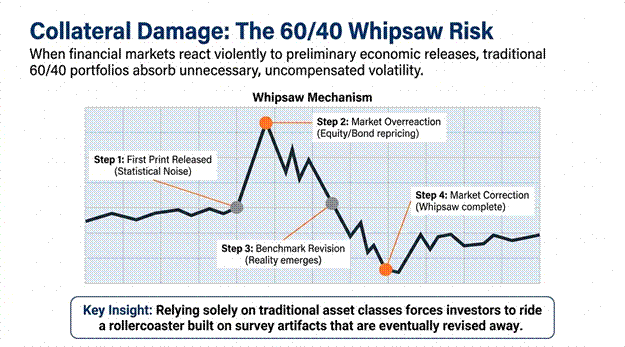
When financial markets react violently to preliminary economic releases, traditional 60/40 portfolios absorb unnecessary volatility. Because equity and bond markets frequently reprice based on preliminary survey data that is later revised away, relying solely on traditional asset classes exposes investors to whipsaw risk.
Market neutral fixed income strategies seek to capture relative value opportunities across debt instruments while limiting net exposure to benchmark interest rates and overall duration. By identifying pricing differences between related fixed income instruments, these strategies seek to produce returns that are less dependent on the direction of interest rates and traditional fixed income markets. These objectives are not guaranteed.
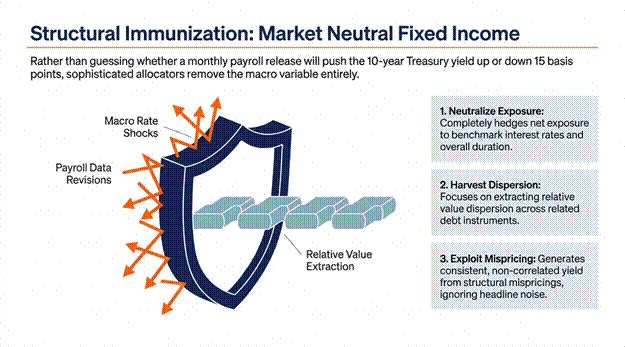
Rather than attempting to predict whether a monthly payroll release will cause Treasury yields to rise or fall, a market-neutral fixed income strategy seeks to reduce sensitivity to macroeconomic rate movements. When successful, the strategy may provide diversification, help moderate portfolio volatility during certain rate shocks, and generate income that is less dependent on the direction of interest rates. The strategy can nevertheless experience losses, and these results are not assured.
Next Step: Request information on our market neutral fixed income strategy.
This Caught My Eye
I use Ground News. It is a news aggregator that will change how you process information: rather than feeding you a single algorithmic narrative, Ground News aggregates coverage for every story from over 50,000 sources worldwide and displays them side by side.
It evaluates each headline by political bias, media ownership, and blind spots, highlighting which topics are covered heavily by one side of the spectrum and ignored by the other. In an environment where media consolidation and narrative bias dominate mainstream reporting, seeing the distribution of coverage across outlets provides structural clarity. It is an exceptionally unbiased tool for seeing how stories are framed before sentiment reacts. Ground News offers a free tier, so give it a try.
Infographic Summary
Halbert Wealth Management is an SEC-registered investment advisor. Investments in alternative strategies are speculative, involve substantial risk of loss, and are not suitable for all investors. Past performance does not guarantee future results.

Spencer Wright is the Executive Vice President of Halbert Wealth Management, Inc. and the author of Forecasts & Trends. He has been with HWM for over 25 years.