Quick Take
Ten-year yields hanging near 4.50%–5.00%, with the 30-year at 5.36%, look less like a spike and more like a reset in what credit costs. That climb has left about $2.0 trillion in paper losses on bank books, put 44% of office debt underwater, and pushed federal net interest past $1.0 trillion a year. One response: move toward alternative fixed income and floating-rate credit, so you can take today’s yields without sitting through duration’s principal hits.
The Lead
From 2009 through 2021, central bank buying kept the 10-year Treasury yield in a low band, roughly 0.50% to 3.00%, and under 0.60% in 2020. Cheap money taught a whole cohort to discount cash flows low and treat bonds as the automatic hedge when stocks sold off. That stretch is over.
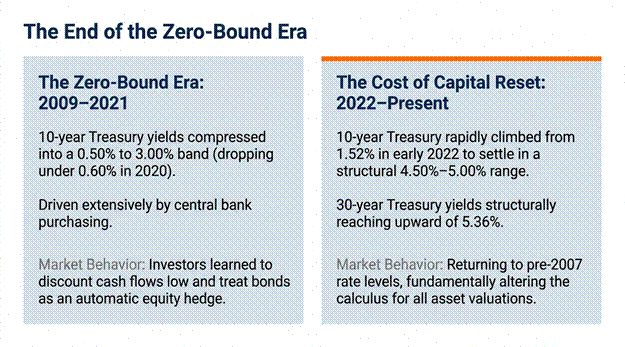
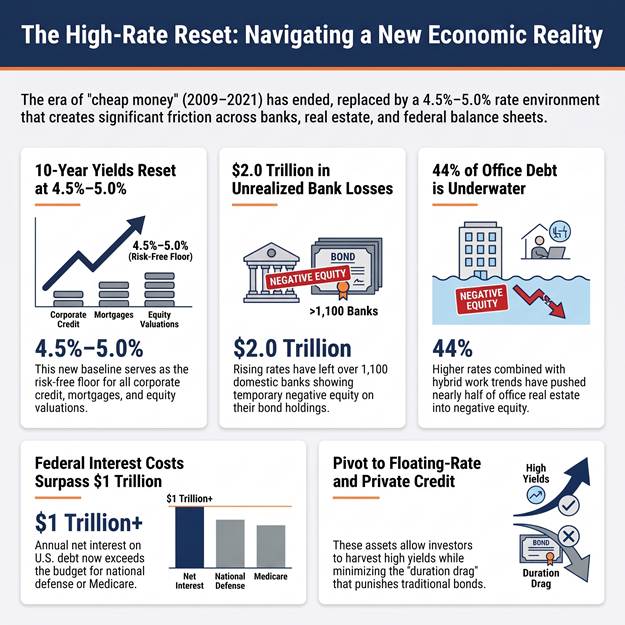
The 10-year went from 1.52% early in 2022 to 3.88% by year-end, then settled in the 4.50%–5.00% range while the 30-year touched 5.36%. Treasury yield sets the risk-free floor for corporate credit, mortgages, and cash-flow valuations. As such, a return toward pre-2007 rate levels puts friction through the system, banks, real estate, the federal balance sheet, and equity multiples alike.
Unrealized Bank Losses
When rates rise, existing fixed-rate bonds fall in price. That mechanical hit produced roughly $2.0 trillion in unrealized paper losses across U.S. bank balance sheets, about $1.2 trillion if you use more conservative loan-payoff assumptions. Stability work on this points to a blunt outcome: with the 10-year Treasury yield stuck between 4.00% and 5.00%, more than 1,100 domestic banks show temporary negative equity on those marks.
Commercial Property and the Lock-in Problem
Higher baseline rates land on commercial real estate just as hybrid work has cut many building cash flows. About 14% of commercial loans overall, and 44% of office debt, sit in negative equity. Roughly 43% of commercial property loans also face refinancing in the near term. If defaults run 10% to 20%, regional banks could face another $80 billion to $160 billion in credit losses, the kind of pressure that leads to extend-and-pretend.
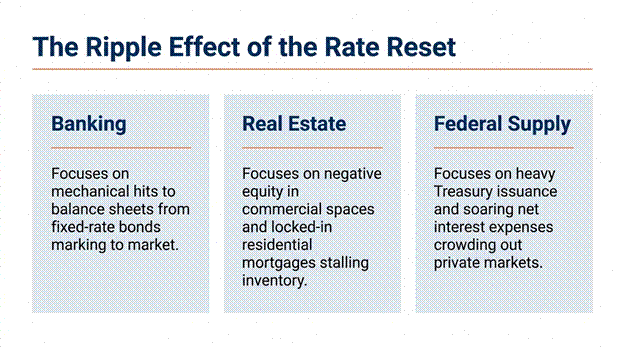
Housing feels a parallel bind. With the 10-year Treasury at this yield, 30-year mortgages run about 6.30% to 7.50%. Owners sitting on 3% loans stay put. Listings stay thin.
Federal Supply and Equity Multiples
Annual deficits of $1.85 trillion to $2.00 trillion mean private markets have to absorb heavy Treasury issuance without the Fed as buyer of last resort. Net federal interest has crossed $1.0 trillion a year, more than national defense or Medicare. Rolling that debt at higher yields feeds the next deficit. Higher risk-free rates also squeeze the equity risk premium. Stocks get jumpy when the 10-year jumps more than 3 basis points in a day.
What You’re Missing
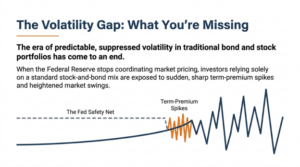
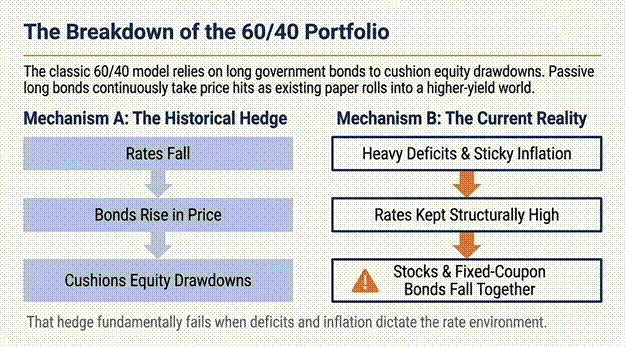
A classic 60/40 leans on long government bonds to cushion equity drawdowns. That hedge fails when big deficits and sticky inflation keep rates high, stocks and long fixed-coupon bonds can fall together. Passive long bonds keep taking price hits as paper rolls into a higher-yield world.
Many institutions are answering with alternative fixed income and floating-rate credit. Coupons on floating-rate paper reset with the benchmark, so duration risk stays low, principal holds up better, and the income can track the new rate floor. Pair that with private credit that pays contractual cash flows without the daily mark of public bonds, and the profile skews toward harvesting elevated yields without the duration drag that has punished traditional allocations.
Next Step
Schedule a short portfolio review with our team. We can look at your duration exposure and whether an alternative or floating-rate credit sleeve fits.
This Caught My Eye
I am a user of EconPi’s (www.econpi.com) Baseline and Rate of Change (BaR) grid. A lot of macro coverage arrives already framed. BaR is duller in a useful way: it plots raw metrics against history and against their own rate of change.
What stood out is why the broader economy has not tipped into recession even with soft consumer sentiment and weak small-business optimism. Corporate profits, low unemployment claims, and subdued financial-stress readings still sit above baseline and keep the aggregate above recession lines. Looking at those coordinates beats arguing with the headline of the day.
Infographic Summary
Halbert Wealth Management is an SEC-registered investment advisor. Investments in alternative strategies are speculative, involve substantial risk of loss, and are not suitable for all investors. Past performance does not guarantee future results.

Spencer Wright is the Executive Vice President of Halbert Wealth Management, Inc. and the author of Forecasts & Trends. He has been with HWM for over 25 years.