Issue No. 14 | September 29, 2026
| The Quick Take… The Big-5 hyperscalers (Amazon, Meta, Microsoft, Oracle and Google) capital expenditure is projected to reach $775B–$800B by 2026 (~5% of US GDP), representing an unprecedented infrastructure deployment that surpasses historical industrial booms. To address mounting physical power constraints and cash flow limits, private credit and asset managers are stepping in to bridge an estimated $800B funding gap through off-balance-sheet SPVs and GPU-collateralized loans. |
The Lead
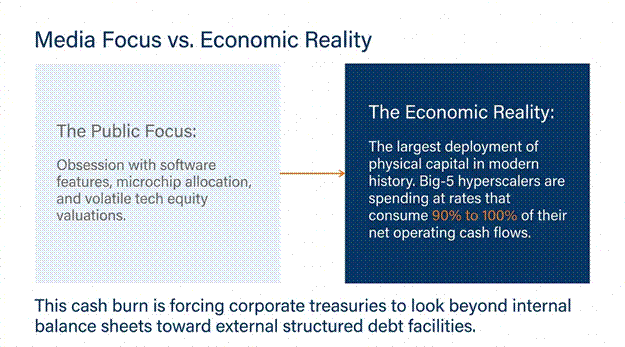
Media commentary remains focused on software features, but the primary economic story is the physical volume of capital deployment. Big-5 hyperscalers are spending at rates that consume 90% to 100% of their net operating cash flows. This cash burn is forcing corporate treasuries to look beyond internal balance sheet reserves toward external private credit markets and structured debt facilities.
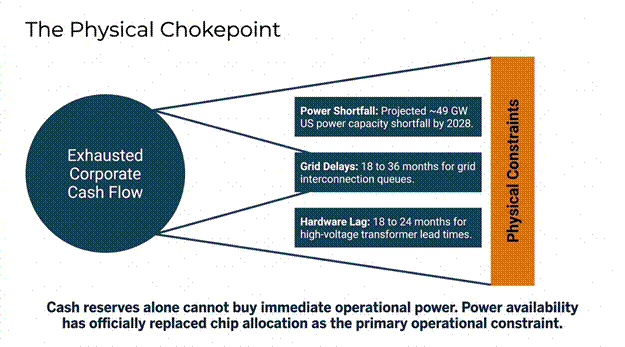
At the same time, real-world friction is mounting. Power grid interconnection queues extending 18 to 36 months and high-voltage transformer lead times of 18 to 24 months mean that cash reserves alone cannot buy immediate operational power. Because physical grid limits and cash flow constraints prevent tech companies from funding everything internally, private capital is stepping in to finance physical computing infrastructure.
Capital Deployment Without Historical Precedent
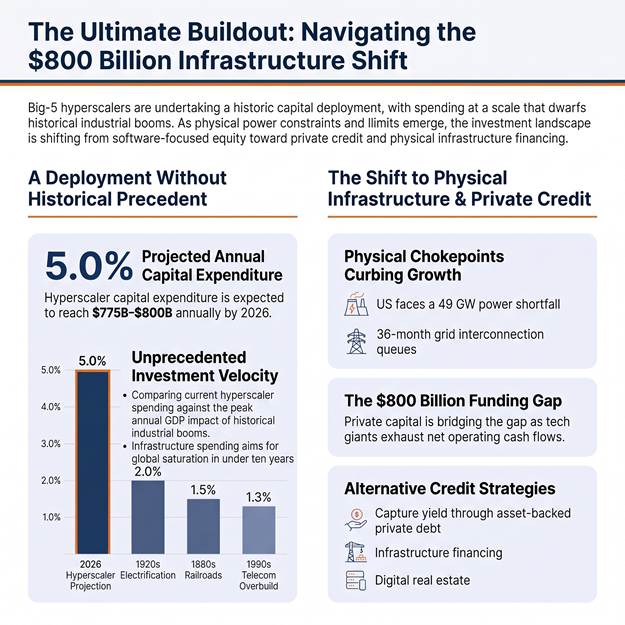
When measured against national output, current technology spending lacks modern precedent. Hyperscaler capital expenditure alone is projected at ~5.0% of US GDP in 2026, while broader multi-year models estimate total data center and utility spending at 3.6% of annual GDP through 2032.
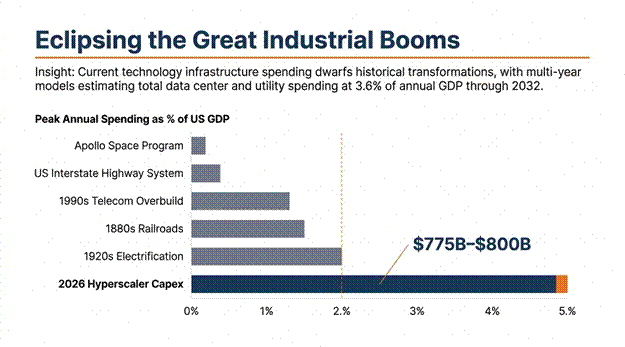
To put this in perspective, peak annual spending for 1880s Railroads reached ~1.5% of GDP, 1920s Electrification hit ~2.0%, and the 1990s Telecom overbuild peaked at ~1.3%. For further context, the US Interstate Highway System peaked at ~0.4% of GDP, while the Apollo Space Program peaked at ~0.2%. Moreover, prior industrial transformations unfolded across three to four decades, whereas current infrastructure spending is attempting compressed global saturation in under ten years.
Physical Chokepoints and Regional Anchors
Power availability has replaced chip allocation as the primary operational constraint. The US faces a projected ~49 GW power capacity shortfall by 2028, driven by 18-to-36-month grid queues and 18-to-24-month transformer lead times. To secure uninterrupted 24/7 baseload power, tech firms are signing long-term nuclear Power Purchase Agreements (PPAs) that directly fund plant restarts, including the 835 MW Crane Clean Energy Center at Three Mile Island Unit 1 and the 1,121 MW Clinton Clean Energy Center.
Regionally, these campuses serve as powerful economic anchors. Meta’s Hyperion campus supports 500 permanent operational jobs alongside thousands of construction roles in Louisiana, while the Clinton PPA secures $13.5 million in annual local tax revenues. Internationally, this spending drives export surges across Asian technology manufacturing hubs.
What You’re Missing
Traditional stock and bond portfolios leave investors exposed to technology equity volatility and hardware obsolescence. As tech giants absorb their cash flows into physical buildouts, private capital is stepping in to fill an estimated $800 billion funding gap.
Instead of betting on tech stocks, institutional investors can capture contractual income by financing the physical backbone of the buildout:
- Asset-Backed Private Debt: Funding physical computing equipment through senior loans secured directly by hardware assets and long-term customer contracts.
- Infrastructure Financing: Providing capital for data center construction backed by long-term corporate leases and credit guarantees.
- Digital Real Estate: Investing in permitted, grid-connected data center sites where North American vacancy sits at a record low of 1.4%.
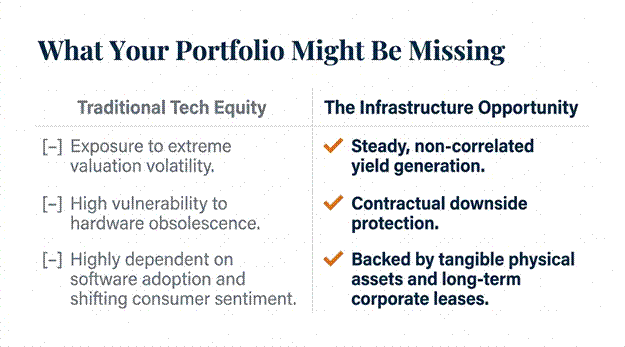
These strategies allow allocators to generate steady, non-correlated yield while securing contractual downside protection. Contact Halbert Wealth Management today to request our alternative credit brief or schedule a review of your portfolio.
| Ready to learn more? HWM offers investments that will allow you to participate in this historic buildout. Contact us to find out how. |
This Caught My Eye

I recently read “A Thread Across The Ocean” , a historical account of the 19th-century transatlantic telegraph cable deployment. I became interested in the subject while I was on vacation this summer. The book contains some interesting parallels to what is happening today. It is a fascinating read that I recommend.
Infographic Summary
Halbert Wealth Management is an SEC-registered investment advisor. Investments in alternative strategies are speculative, involve substantial risk of loss, and are not suitable for all investors. Past performance does not guarantee future results.

Spencer Wright is the Executive Vice President of Halbert Wealth Management, Inc. and the author of Forecasts & Trends. He has been with HWM for over 25 years.