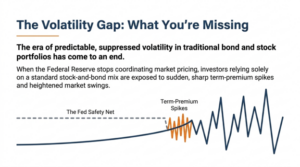
| The Quick Take… Main Market Takeaway: Portfolio losses take an asymmetric toll on long-term wealth, turning temporary drops into multi-year delays for your financial goals. Core Analysis Theme: Why average annual returns hide actual losses, and how inflation doubles the time required to rebuild true buying power. Featured Alternative Spotlight: Buffered index allocations that participate in equity upside while establishing a defined risk framework to mitigate drawdowns. |
The Lead
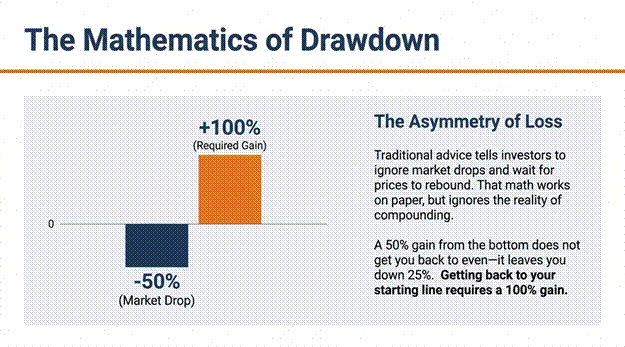
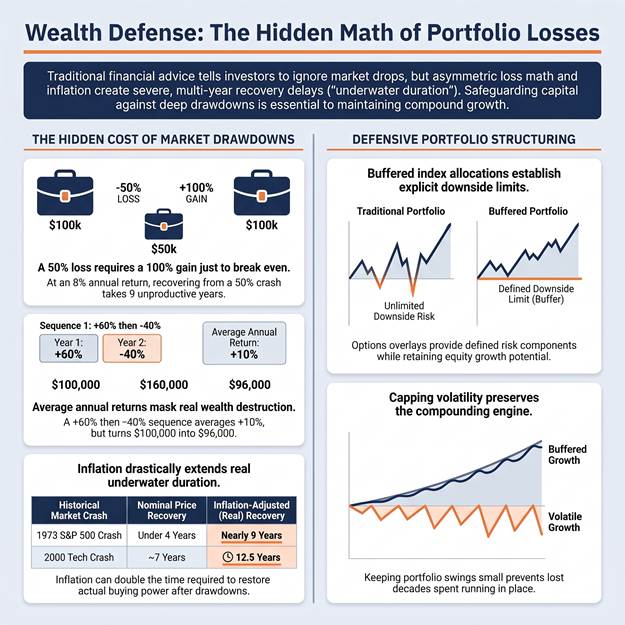
Traditional advice tells investors to ignore market drops and wait for prices to rebound. That math works on paper, but it ignores the reality of compounding. If your portfolio loses 50%, a 50% gain does not get you back to even. It leaves you down 25%. Getting back to your starting line requires a 100% gain. At a steady 8% annual return, climbing out of a 50% hole takes nine years. Those nine years generate zero new wealth. You are simply running in place to rebuild lost principal. For anyone nearing retirement or drawing income, spending a decade recovering from a crash creates permanent damage to a financial plan.
The Core Analysis
The Average Return Trap
Wall Street loves to showcase average annual returns, but averages lie. Wealth grows through compound returns, not simple arithmetic averages. Consider a portfolio that gains 60% in year one and drops 40% in year two. The average annual return looks strong at 10%. Yet a 100,000 dollar starting balance ends up at 96,000 dollars. You lose 4% of your capital despite a positive average.
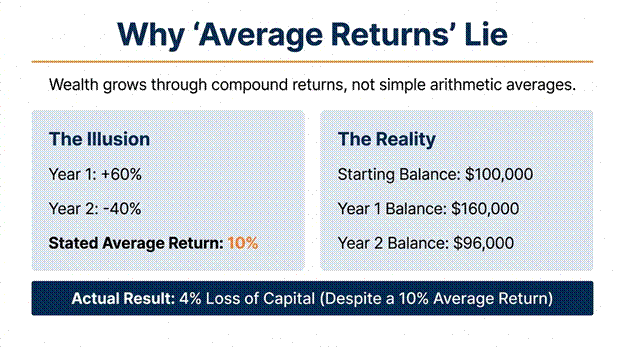
Volatility acts as an explicit tax on long-term growth. As portfolio swings widen, the gap between reported average returns and your actual compound wealth expands. Keeping those swings small preserves the compounding engine.
The Real Cost of Underwater Duration
Headline numbers focus on how far markets fall from peak to trough. What actually breaks a retirement plan is underwater duration, the time spent waiting to get back to even. Nominal price recoveries also hide purchasing power damage.
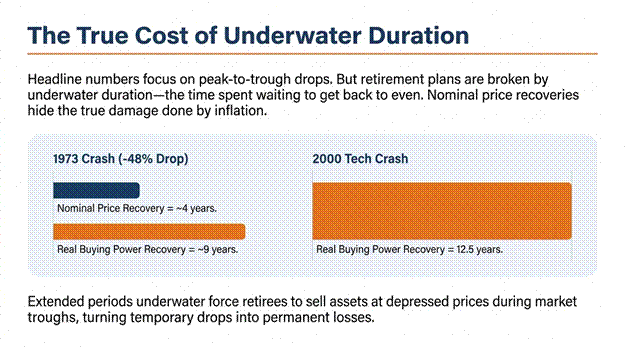
During the 1973 crash, the S&P 500 fell 48%. Stock prices regained their nominal peak in under four years. When you factor in double-digit inflation, however, restoring actual buying power took nearly nine years. After the 2000 tech crash, real recovery required twelve and a half years. Extended periods underwater can require retirees who rely on portfolio withdrawals to sell assets at depressed prices during market troughs, turning temporary drops into permanent losses.
What You’re Missing
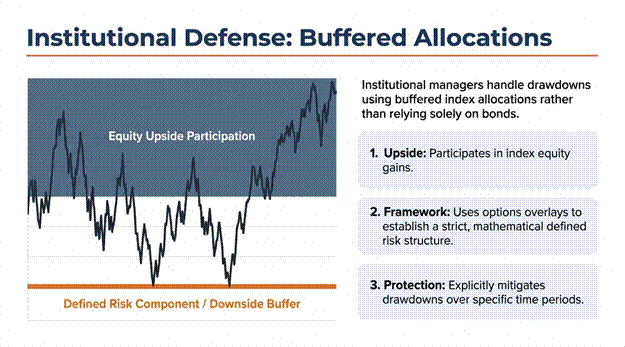
Traditional portfolios rely on bonds to balance stock volatility. That approach breaks down when inflation spikes and interest rates rise. Institutional managers handle market drawdowns by using buffered index allocations.
| Ready to learn more? Schedule a call with us to evaluate how a defined risk overlay fits your allocation. |
These allocations participate in index equity gains while using options overlays to establish a defined risk component that mitigates drawdowns over a specific period. By setting explicit buffers on downside losses, investors retain equity growth potential without leaving their portfolios exposed to unhedged market crashes.
This Caught My Eye
I have been tracking prediction markets like Polymarket and Kalshi through this election cycle. They are generally reliable at forecasting major outcomes because people wager real money on who they believe will win, reacting and updating odds much faster than traditional opinion polls. However, they are not foolproof crystal balls. Traders frequently overpay for extreme longshots, treating low-probability candidates like lottery tickets, and wealthy investors can distort market prices by placing massive single wagers. Ultimately, these platforms function as fast, highly responsive betting lines rather than infallible truth machines.
Infographic Summary
Halbert Wealth Management is an SEC-registered investment advisor. Investments in alternative strategies are speculative, involve substantial risk of loss, and are not suitable for all investors. Past performance does not guarantee future results.

Spencer Wright is the Executive Vice President of Halbert Wealth Management, Inc. and the author of Forecasts & Trends. He has been with HWM for over 25 years.