Issue No. 17 | October 20, 2026
Market Murders
| The Quick Take… Main Market Takeaway: Postwar economic expansions and bull markets do not die of simple old age; they are ended by central bank overtightening, sudden economic shocks, or financial bubble collapses. Core Analysis Theme: Busting the myth of aging market cycles, breaking down the primary causes of market downturns, and mapping the warning signs that appear before a peak. Featured Alternative Spotlight: Non-correlated private market strategies that sit outside public equity exchanges to protect capital regardless of central bank shifts. |
The Lead
Wall Street commentary often treats long-running market rallies with creeping paranoia, warning investors that an aging bull market is living on borrowed time. In reality, calendar age has nothing to do with when a market cycle ends. As MIT economist Rudi Dornbusch famously put it, “None of the postwar expansions died of old age, they were all murdered by the Fed.”
Decades of economic research confirm that expansions do not get frail simply because they have been running for a few years. A market cycle that is six years old is no more likely to collapse in any given month than one that is three years old. Bull markets do not expire from exhaustion. They are pulled down by specific catalysts, usually aggressive interest rate hikes, sudden supply disruptions, or the collapse of over-leveraged financial bubbles.
The Core Analysis
Who Kills the Bull Market?
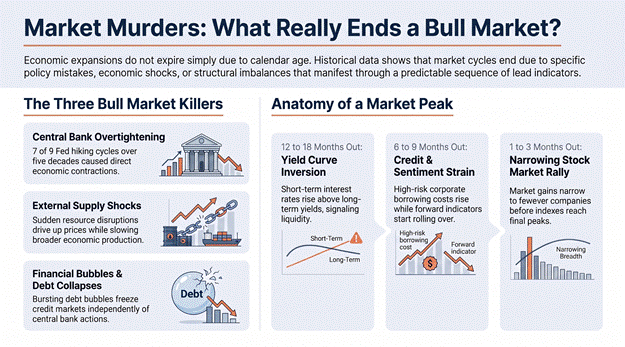
Looking across modern economic history, market expansions end because of three specific triggers:
- Central Bank Overtightening: The primary culprit behind most economic downturns is the central bank raising interest rates too aggressively. When strong growth and tight labor markets push up inflation, policymakers raise rates to cool demand. Because rate hikes take time to filter through the economy, central banks routinely overshoot, making borrowing too expensive, squeezing corporate cash flows, and forcing a recession. Out of nine rate-hiking cycles over the past five decades, the Federal Reserve managed a smooth soft landing only twice; the other seven led directly to economic contractions.
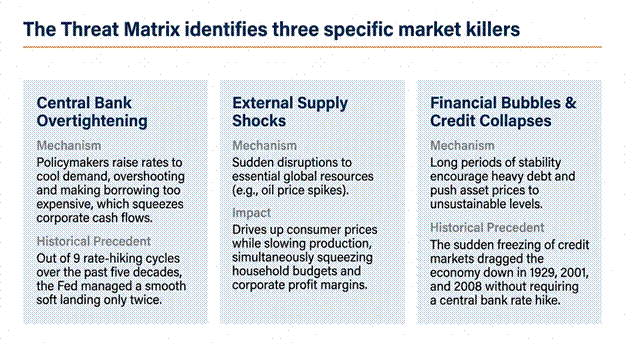
- External Supply Shocks: Sudden disruptions to essential global resources, such as sharp oil price spikes, can shock an economy overnight. These shocks drive up consumer prices while slowing down production, squeezing household budgets and corporate profit margins at the same time.
- Financial Bubbles and Credit Collapses: Long periods of economic stability naturally encourage risk-taking. Investors and corporations accumulate heavy debt, pushing asset prices to unsustainable levels. When these financial bubbles burst, as they did in 1929, 2001, and 2008, the sudden loss of wealth and freezing of credit markets drag the economy down without needing an interest rate hike from the central bank.
Busting the Old Age Myth
Statistical studies of post-WWII business cycles prove that economic expansions do not have a natural biological expiration date. Older expansions are not inherently weaker or more fragile than younger ones.
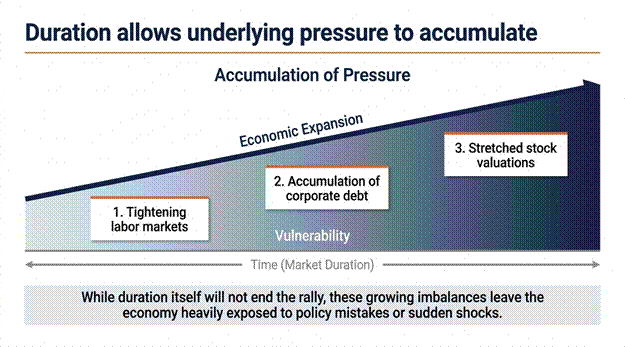
However, time does allow underlying pressure to build beneath the surface. As an expansion matures, labor markets tighten, corporate debt accumulates, and stock valuations stretch thin. While duration itself will not end the market rally, these growing imbalances leave the economy increasingly vulnerable when a policy mistake or sudden shock occurs.
The Anatomy of a Market Peak
Rather than watching the calendar, investors can track a clear sequence of economic warning signs that typically show up 6 to 18 months before a peak:
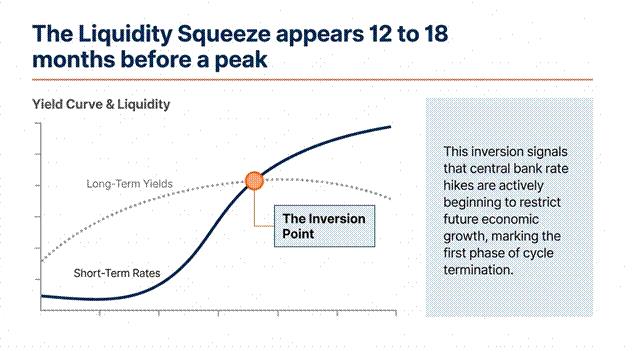
- 12 to 18 Months Out (The Liquidity Squeeze): Short-term interest rates rise above long-term yields (a yield curve inversion). This signals that central bank rate hikes are beginning to restrict future economic growth.
- 6 to 9 Months Out (Credit and Sentiment Strain): Borrowing costs for higher-risk corporations begin to rise as bond investors demand higher risk returns. Real money growth slows down, and forward-looking indicators like housing permits and business confidence surveys start to roll over.
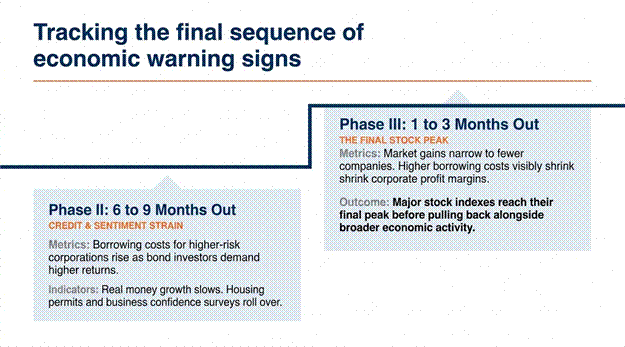
- 1 to 3 Months Out (Stock Market Peak): Market gains narrow to fewer companies, profit margins shrink under higher borrowing costs, and major stock indexes reach their final peak before pulling back alongside broader economic activity.
What You’re Missing
Traditional stock and bond portfolios leave investor wealth fully exposed to the public equity market’s sudden turns and central bank policy swings. Institutional investors manage this vulnerability by allocating to non-correlated private market strategies, such as private credit, direct infrastructure, real assets, and private yield funds.
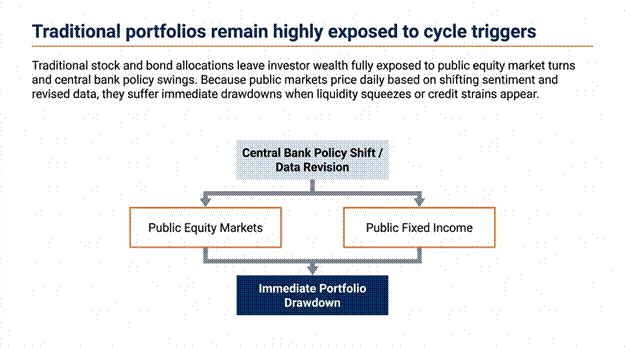
Because these private assets operate outside public stock exchanges, their cash flows and valuations are not tied to daily market sentiment, liquidity crunches, or sudden equity sell-offs. Incorporating non-correlated private strategies helps insulate portfolios against public market drawdowns while delivering stable returns no matter what phase the market cycle is in. To explore how non-correlated private allocations can strengthen your portfolio, request our Alt Assets Explainer or schedule a review with our team.
| Ready to learn more? Download our Alternative Assets Explainer |
This Caught My Eye
I was tracking policy revisions recently and ran across a clear example of decisions made on wet paint. When the Fed raised rates in September, part of the case rested on July core inflation of 3.3%.
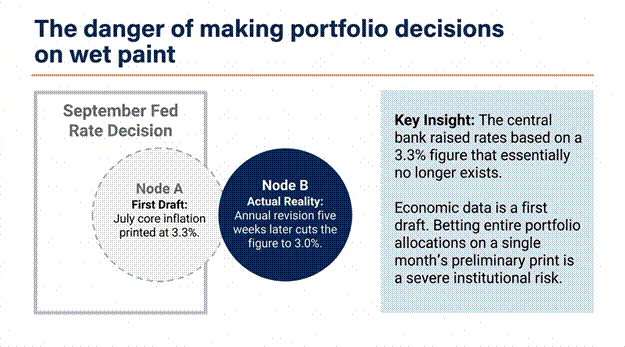
Five weeks later, the government’s annual revision cut that figure to 3.0%, meaning one of the numbers behind the decision no longer exists. It is a useful reminder for all of us: economic data is a first draft, and the wisest course is never to bet everything on a single month’s print.
Infographic Summary
Halbert Wealth Management is an SEC-registered investment advisor. Investments in alternative strategies are speculative, involve substantial risk of loss, and are not suitable for all investors. Past performance does not guarantee future results.

Spencer Wright is the Executive Vice President of Halbert Wealth Management, Inc. and the author of Forecasts & Trends. He has been with HWM for over 25 years.